Getting Around Abidjan: Taxis, Woro-woro, Gbaka and Water Buses
By Victor Tseng 曾浩瑜4 min
Abidjan, the economic capital of Côte d'Ivoire (in West Africa, French-speaking, the world's largest cocoa producer), is split into several parts by its lagoon, which makes its transport unusually varied. First-time visitors are often confused by the many brightly coloured vehicles on the road; once you understand the role of each, scheduling meetings and getting around becomes much smoother.
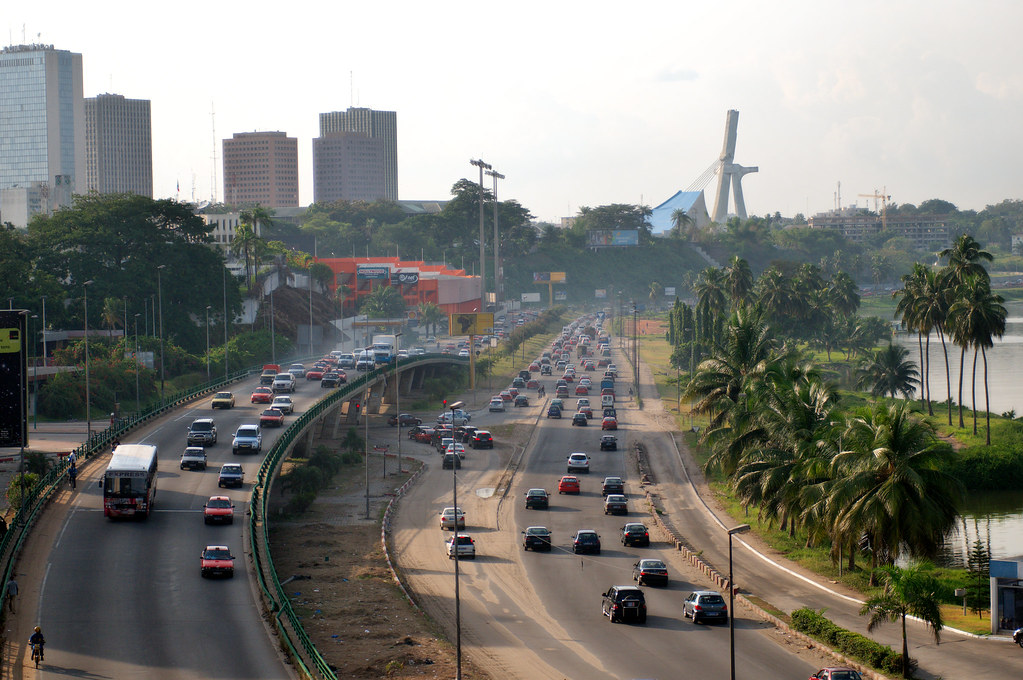
Taxis: orange cabs go everywhere, woro-woro stay local
Abidjan's taxis fall broadly into two types. Orange taxis can travel between all districts of the city and are the most common choice for business visitors; the transport guidance given to participants at the 2022 Africa Investment Forum also recommended orange taxis as the main option, listing ride-hailing apps such as Yango and Uber as alternatives.
The other type is the woro-woro, a "district shared taxi". It follows fixed routes, with passengers sharing the ride at a standard fare, and usually operates within a single commune. Every district except the administrative centre, Plateau, has its own woro-woro, distinguished by body colour: Adjamé, Attécoubé, Marcory and Koumassi are green, for example, Cocody is yellow, Yopougon is blue and Abobo is beige with two brown stripes. The name is said to come from the word for "six" in Malinké, a language of the north: in the early days the cars were licensed to carry five passengers but actually carried six.
Gbaka minibuses and SOTRA buses
The gbaka is a privately run minibus that travels between districts. Like the woro-woro, it grew up outside the public system and now carries a large share of daily commuting. These vehicles used to stop wherever passengers hailed them, causing congestion; in August 2022 AMUGA, the urban transport authority for Greater Abidjan, began piloting dedicated woro-woro and gbaka stops in Yopougon, with plans to extend them to other districts.
The public Abidjan transport company SOTRA runs the city bus network and also offers air-conditioned coaches for hire. For visitors unfamiliar with the routes and not yet fluent in French, gbaka and bus stop names and routes are harder to master, so it is best to have a local colleague with you the first time.
Water buses: another way across the lagoon
Because the lagoon divides the city, water transport is a practical commuting option. Alongside SOTRA's fleet, private operators have entered the market since the end of 2016, including STL (Société des Transports Lagunaires); the 2022 forum transport guidance listed two private ferry operators, Aqualine and STL. The services planned by operators cover lagoon-side areas including Yopougon, Adjamé, Plateau, Treichville, Cocody and Koumassi. When the roads are jammed at peak times, the boat is often the more reliable option — and it offers a view of the city skyline from the water.
The metro: a little longer to wait
Construction of Abidjan Metro Line 1 began in November 2017, with opening originally planned for 2022. In December 2025 the transport minister said the works were on schedule and would be delivered at the end of 2028, with 24 stations along the line. Until then, road and water transport remain the mainstays.
| Mode | Coverage | Best for |
|---|---|---|
| Orange taxi / ride-hailing app | Whole city | Business meetings, travelling with luggage, night-time |
| Woro-woro | Fixed routes within one district | Short trips within a district |
| Gbaka | Between districts | Daily commuting once you know the routes |
| SOTRA bus | Citywide network | Commuting on fixed routes |
| Water bus | Stops along the lagoon | Avoiding road traffic at peak times |
One line for Asian readers
On a short business trip, rely mainly on orange taxis or ride-hailing apps, group your meetings in the same district and allow extra time for cross-district travel; once you live there, gradually learning the woro-woro and water buses will bring you closer to local daily life.
References: Africa Investment Forum – Hotels and getting around (2022); Le360 Afrique – Les wôrô-wôrô, ces taxis communaux populaires d'Abidjan (2021); Le360 Afrique – Plus d'arrêts anarchiques pour les wôrô-wôrô, gbaka et taxis (2022); Abidjan.net – Transport lagunaire (2017); Oxford Business Group – Urban transport plans for Abidjan; AllAfrica – Ligne 1 du métro livrée fin 2028 (2025); MHEU – Abidjan gbaka
Motif: Strip-woven cloth
More in this topic
- Lifestyle3 min A Beginner's Guide to Abidjan's Markets: What to Buy in Treichville, Cocody and Adjamé Abidjan's markets explained — Treichville for fabric, food and tailors, CAVA for carvings and bronze, Cocody's multi-storey market and Adjamé's food wholesale. Read
- Lifestyle3 min Abissa: The Annual Festival of the N'zima People of Grand-Bassam Abissa, the N'zima traditional new year in Grand-Bassam, Côte d'Ivoire, held around October–November: sacred drum, seven families, criticism and reconciliation. Read
- Lifestyle3 min Assinie: The Coastal Weekend Escape of Abidjan Assinie, 80–90-odd km east of Abidjan between the Aby Lagoon and the Atlantic, is the city's go-to beach getaway. Geography, early history, La Passe and tips. Read